
We're proud to partner with Ecologi.
We support responsible reforestation and ecosystem restoration projects worldwide. Each project is rigorously vetted by Ecologi to ensure the right trees are planted in the right places, with local communities, and safeguarded for the future.
Chest binders help people to feel like themselves
People have bound their chest for thousands of years. Binders minimize the shape of your chest so you can express your gender however you want.
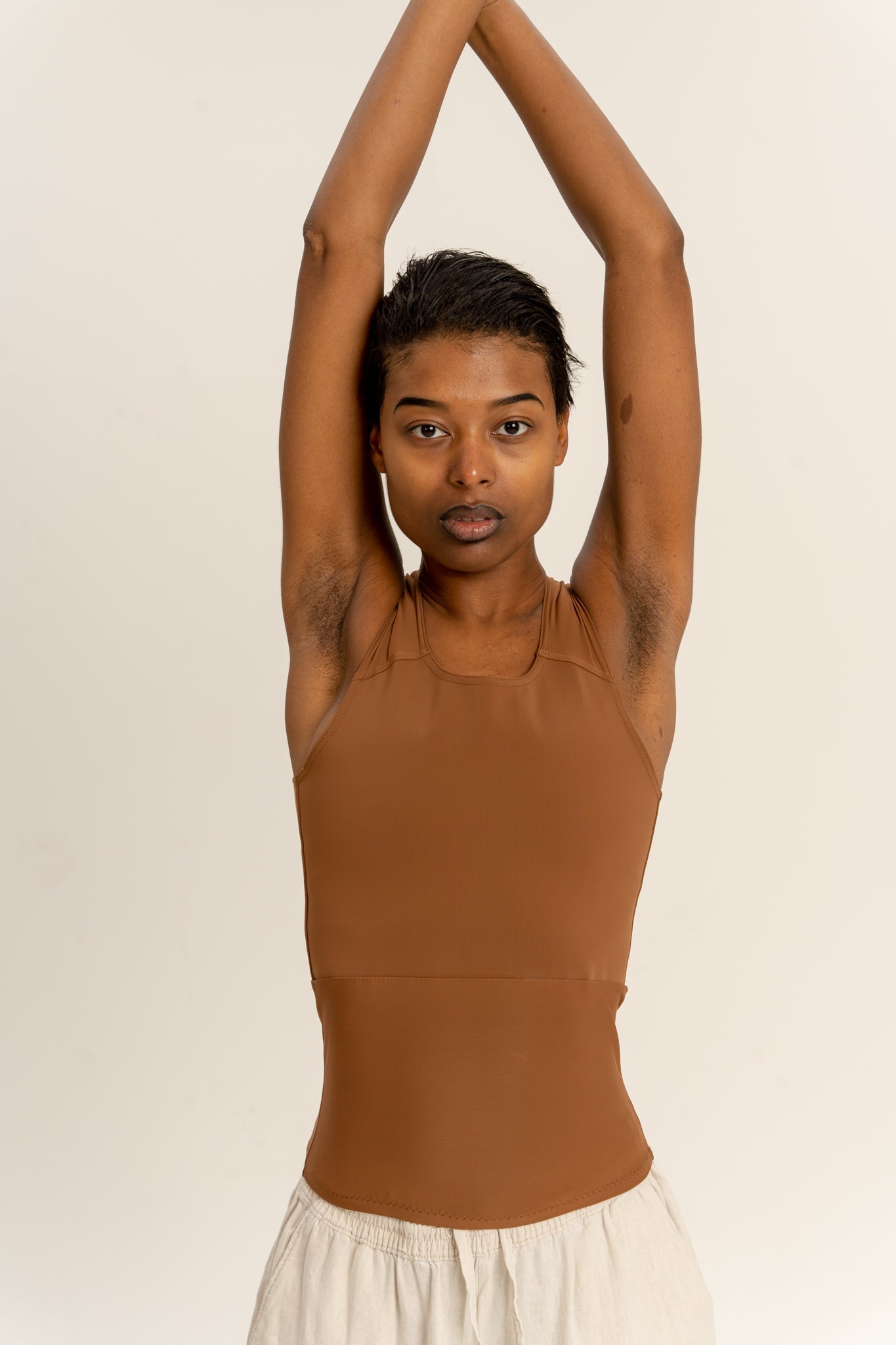
Our unique design* compresses from the back and gives you more room to breathe
The front of our binders is made from very strong corset fabric which holds your front flat while the elasticated back optimises compression.
So you get the full flattening effect with much less pressure on your body.
*Registered UK Design
We're passionate about our responsibility to our planet
The main fabric used to make our binders is made from recycled ocean plastics.
Since we launched in 2017, we have recycled plastic material equal to 122,500 plastic bottles.
We make sure we don't use plastic packaging.
From Sea to Tree: How we transform ocean plastics into chest binders to fund climate action projects across the globe
Our binders are trash. Litter. Garbage. At least, to begin with... Our binders begin life as old carpets, second hand garments, industrial waste, and of course fishing nets. We give this waste new life as chest binders. Find out more here!
Learn moreHow to Customise Your Chest Binder For Cosplay or Halloween
By Robin Bateman Disclaimer: If you paint on your binder, please be aware that you will need to spot clean it from now on, as washing may damage your artwork and will stain your binder. We strongly recommend not painting on a binder that you wear regularly. Happy creating! Whether you want to customise your chest binder for cosplay, create a gender affirming Halloween costume, or just want your binder to feel a bit more you, painting your chest binder is super fun, creative, and pretty simple! This guide will walk you through the process step-by-step — plus a few dos and don’ts I learned the hard way! For this guide, I’m using three examples of chest binder cosplays: The Babadook – we can’t forget our favourite spooky LGBTQ+ icon. Superman – super simple costume, fun for Comic-Con, and a classic. Also, the new movie? I might be a bit too obsessed Luffy (One Piece) – for all the weebs! Recognisable, easy, and great if you wish you could cosplay a shirtless character (but haven’t had top surgery). What You’ll Need Before we begin, gather your materials: Your binder (dark colours work, but light ones really pop!) Fabric paint Fabric medium (don’t skip this — it makes the paint flexible and the binder washable afterwards) Pencils, pens, or chalk (for sketching) Masking tape (optional but helpful) Paintbrushes A hair dryer (for setting layers) Reference image or sketch of your design Old clothes to paint in! (trust me on this) Step 1: Choose Your Cosplay or Halloween Design Start with a character, pattern, or anything else that you’d like to paint onto your chest binder. This can be as simple or complex as you like - sketch your own idea, print out a reference, or pull up an image on your phone or laptop. Think about what you’ll use it for — cosplay? Pride events? The choice is yours. Step 2: Sketch or Tape It Out Lightly sketch your design on your chest binder using pencil or chalk. You can also use masking tape to block out clean lines or sections if your design needs sharp edges. Be careful not to sketch too darkly onto light binders as the lines might still show up underneath your paint. Also remember – some masking tape will let paint through slightly, the lines will help as a guide, but won’t always give precise, clean lines. Step 3: Mix Your Paints with Fabric Medium This is crucial: mix every colour 1:1 with fabric medium.Fabric medium helps the paint stay flexible, prevents cracking, and keeps the design washable. It will thin your paint, so you’ll need more layers, but your future self (and your binder) will thank you. Step 4: Lay Down a Base Coat If you’re going for a vibrant design, start with a white base layer — it helps the colours stay bright! Let each layer dry completely before adding another. For speed, use a hair dryer between coats (on low/medium heat). Step 5: Add More Layers This part can be a bit boring, but it’s worth it. Apply multiple coats of paint, letting each one dry before moving on. Use your hair dryer in between to speed up the process. The smoother the base, the better your final design will look. Step 6: Paint Your Final Design Now for the fun part — the top layer! Take your time adding in details, colours, and outlines. Remember: Light colours go first Darker colours layer on top(It’s much easier to cover up light colours with dark ones rather than vice versa! Plus, then there’s no need to awkwardly try and avoid mixing the light colour with the dark outline by mistake and ending up with a gross muddy colour instead of what you really wanted) Step 7: Heat Set the Design Once you’re happy with your design, heat set your design using a hair dryer. This helps the paint bond to the fabric and stay in place when worn or washed. (⚠️ Do NOT use an iron — it can melt your binder and ruin your hard work!) Washing & Care Spot wash by hand when needed. The design should hold up well if you used fabric medium, but some fading is likely over time. Also be aware that there is always a risk that parts of the design will smudge if fully submerged in water, so be very careful and be prepared for touch-ups in future! Dos & Don’ts ✅ Do: Mix paint with fabric medium 1:1 every time Apply multiple coats Sketch your design first Use a hair dryer to speed things up and heat set Trust the process — it won’t look perfect at first! Spot clean gently ❌ Don’t: Wear your favourite clothes while painting (paint stains are forever) Paint on a binder that you plan to wear daily Use an iron to heat set Skip the fabric medium — your paint will crack Layer light over dark — start light! Accidentally drink your paint water (not from experience or anything) Happy painting, and don’t forget to take breaks, hydrate (not with paint water), and post your finished look online — we’d love to see it!
Learn moreCeleb trans allies who put a certain children’s author to shame 👀
This Pride, we would like to take a second to highlight some positive instances of support from some superstar trans allies. Despite the consistent attacks faced by the trans community, from a certain disgraced children's author and various hateful politicians, there are still lots of people who love and support us. These are just a few of some of the world's most notable allies. Robert De Niro One of the worlds most famous and respected actors has recently come forward in support of his trans daughter. Airyn De Niro, introduced herself to the world this year in a beautiful interview with Them. At the time, when asked about Airyn, De Niro said: “I love and support Airyn as my daughter. I don't know what the big deal is, I love all my children." View this post on Instagram A post shared by BuzzFeed UK (@buzzfeeduk) More recently, he addressed the topic again in an interview with Entertainment Tonight, stating: “Well, there's certain things you can do and certain things you can't do, but the main thing is to support your kids,” He continued: “As long as they’re not hurting themselves, doing anything destructive or anything like that, you have to support them. Period." The two-time Oscar winner is extremely popular with cis men and some of his most notable roles are that of gangsters or other examples of extremely toxic masculinity. In light of this, his supportive comments come as a breath of fresh air, bringing hope that his openness can inspire other cis men. Kate Nash With her new track ‘GERM’ Kate Nash is directly calling out She Who Shall Not Be Named and other TERFs in style. The lyrics address the recent supreme court ruling, highlighting that trans people aren’t a threat to women. “Women are facing serious dangers not during boxing matches or from trans people needing a piss But from actual violence that is carried out against them every week” The song also features important statistics about misogyny and toxic masculinity. In an interview with Attitude magazine, she said: “Feminism is dismantling systems of oppression, so to be transphobic is not feminist. Feminism has to be intersectional. So I wanted that on record, because at the moment, the loudest cultural voice in the room, who created one of the most successful things ever to come out of the UK, Harry Potter, is transphobic, and is very cruel online and very crass, and it’s just become so nasty. I just need to put this out into the world, even just so in history, this exists. I hope that it also allows other cis women and feminists to be more vocal and be less afraid to approach the subject, because I think people are afraid to talk about it.” View this post on Instagram A post shared by Kate Nash (@katenash) Kesha Pop diva Kesha came out swinging for the dolls at London festival The Mighty Hoopla. She headlined the festival rocking a ‘Protect the dolls’ tee and brought out Jake Shears of Scissor Sisters fame to spread some queer love. They performed a mash up of the iconic queer Scissor Sisters track ‘Lets have a kiki’ and Keshas own ‘We R who we R’. View this post on Instagram A post shared by Mighty Hoopla (@mightyhoopla) Pedro Pascal The internet’s daddy, Pedro Pascal, has long been a vocal supporter of trans rights. Most recently, he’s been seen wearing a ‘Protect the dolls tee’ and calling She Who Shall Not Be Named a “heinous loser” in an Instagram comment under a video by writer and activist Tariq Raouf. Pedro’s sister, Lux Pascal, is a trans actress, model and activist. Lux has appeared on a number of Chilean soap operas and dramas as well as appearing alongside Pedro in Netflix’s Narcos. View this post on Instagram A post shared by Pedro Pascal he/him (@pascalispunk) Daniel Radcliffe Award-winning actor Daniel Radcliffe, got his start in the industry appearing as the lead role in the film adaptation of You Know Who’s books. But, in light of her constant attacks on trans people online and in the press, Daniel felt it was important to stand up for trans people. He wrote a statement, published by The Trevor Project a trans non-profit that he has supported for the last decade. In the statement, Daniel states: “Transgender women are women. Any statement to the contrary erases the identity and dignity of transgender people and goes against all advice given by professional health care associations who have far more expertise on this subject matter than either Jo or I.” Jade Thirlwall On Saturday 31 May, pop diva Jade Thirlwall led the crowd of The Mighty Hoopla, in saying “Fuck You” to She Who Shall Not Be Named. Since rising to fame in the pop group Little Mix, Jade has consistently defended the trans community. In 2021 the talented singer won a Gay Times Allyship award in 2021 and more recently commented on her responsibility to speak out against growing transphobia: “Cancel culture is thriving right now. When you're in the public eye, it’s quite scary. I’ve always been vocal, and I’m not always going to get it right. But you can’t be a pop artist these days without speaking out on certain issues” “We’re seeing an attack on the trans community, and with my large LGBTQ+ fanbase, I can’t sit back and not defend that community. I’m happy to face the consequences if it means doing the right thing.” View this post on Instagram A post shared by GLAAD (@glaad)
Learn moreGreer Lankton | Queer artist, doll maker, trailblazer
Original image: Peter Hujar, 1983 Greer Lankton | Queer artist, doll maker, trailblazer A talented artist with a troubled soul, Greer Lankton faced many challenges throughout her life, and her artwork provided her with comfort amidst the chaos. However, some critics believed she relied too heavily on her artwork leading to an obsession, burnout and her eventual undoing. View this post on Instagram A post shared by Greer 💖 Lankton (@greer_lankton_archives_museum) As a child, Greer was drawn to feminine clothing and playing with dolls. As she was AMAB her family wouldn’t allow her to play with ‘feminine’ toys as they disapproved of her breaking the gender binary, so she often made her own dolls out of socks and pipe cleaners to keep her company and give her an outlet to explore gender expression. Even though her self-expression was dimmed by her parents, her early artistic ambitions were supported by them. She entered and won many shows and competitions all over the Midwest, before moving to New York in 1978 in her early 20s to study at the Pratt Institute. View this post on Instagram A post shared by Greer 💖 Lankton (@greer_lankton_archives_museum) Greer became engrossed in the process of creating dolls. She composed them out of soda cans, wire, tape, paper, plaster, stockings and finished them with realistic glass eyes. One was described by Nan Goldin, one of Greers contemporaries and friends, as "A huge cloth hermaphrodite giving birth", this was said to have been made after a dream in which Greer gave birth to herself. Her work mainly focused on sexuality, gender and the effects of consumerism, with Goldin suggesting that “In bringing her dolls to life, Greer worked through her own traumas with her dolls”. Lankton battled with an eating disorder for many years, and her unhealthy relationship with food was expressed within her dolls. Many were seen with flared ribs, emaciated, while others were unhealthily overweight. The creation of her art was intertwined with her own life and complicated relationship with body image. Hilton Als, an American writer and Theater critic, wrote how ‘’No artist is down on her luck when she has her art. It’s what Greer fed on, even when she ate no other food at all. Her dolls were starved for our attention.”. Greer also struggled with continuous substance abuse when she relocated to New York, which also had influence on many of her doll’s looks. They were a reflection of her own addictions, traumas and struggles with her gender identity. View this post on Instagram A post shared by Greer 💖 Lankton (@greer_lankton_archives_museum) Like herself, Greer’s dolls were constantly being reworked – she had an approach that the human body was in a constant state of metamorphosis, influencing her into obtaining a habit of changing the doll’s size, gender, and clothes frequently. In some way, she was her very own doll surrounding herself with a family of ‘freaks’. Greer derived much of her inspiration from celebrities as well, creating them in glamorous and sometimes haunting lights. Some examples would include; Candy Darling and Divine. Greer underwent gender-affirming surgery aged 20 in 1979. At this time the surgery was riskier and more experimental than today. Her husband, Paul Monroe says she suffered from pain and complications from the surgery until her death. View this post on Instagram A post shared by Greer 💖 Lankton (@greer_lankton_archives_museum) Greer and Paul were married in 1987 and are said to have divorced in 1992 although Paul himself states they never really divorced. In the early 90’s while dealing with the loss of many of her friends through the aids pandemic she moved back to Chicago to focus on her own ill health. Her career began to dwindle from the art world until, in 1995, she got given an opportunity to put on an exhibition for the Mattress Factory in Pittsburgh. Margery King, the curator of The Mattress Factory and Michael Olijnyk, went to visit Greer about the exhibition, arriving in Greer’s small apartment which was overflowing with her dolls in all stages of production. Her home was such an incredible display of her talent, Michael and Margery both agreed that Greer could reproduce an installation inspired by her apartment for the exhibition. View this post on Instagram A post shared by Greer 💖 Lankton (@greer_lankton_archives_museum) Many agree that those last moments of Greer bringing to life her installation, ‘It's all about ME not you’, were some of her happiest in a while. She was surrounded by admirers and completely engrossed in her work. Though down to 90 pounds, she always wore a smile, and her work ethic was beyond extraordinary. She sadly passed not even a month after the exhibition had been unveiled to the public by accidental overdose. Greer’s passion for her art allowed her to have a creative outlet for her pain and suffering during her struggles with substance abuse, addiction and a severe mental health disorder. Greer’s friend and photographer Nan Goldin described Greer’s work as “so visceral, so exposed, that I once told her it was like an operation without anesthesia.” Critics may have said her obsession with her art bought about her eventual undoing, but according to those closest to her it seems like she used her creative outlet as a form of therapy. Greer granted other queer and trans individuals the opportunity to be seen; something so valuable during her lifetime and today. Sources https://greerlankton.com/ https://www.artnet.com/magazineus/features/morton/morton1-26-07.asp By Julia Morton https://www.artforum.com/features/greer-lankton-162842/ By Nan Goldin https://www.artsy.net/article/artsy-editorial-1980s-icon-greer-lankton-explored-glamour-gender-eerie-dolls By Alina Cohen
Learn more
Help us improve
In order to better understand how we can serve our customers, we have created our Customer Needs Survey. If you feel comfortable, we would love to hear from you about yourself and your needs. Don't worry though, the form and your answers are anonymous.